
Why we're always cooking 👩🍳👨🍳
I talk to my husband about one of our shared pastimes.

In this newsletter…
👨🍳 A conversation with my food-savvy husband!
🥘 Our cooking book gets a cover makeover!
🐋 An action-adventure novel about saving the whales!
It’s been almost six years since my husband Jake and I released our co-written book, WHY AREN’T YOU COOKING? It’s not a cookbook, it’s a “how to cook” book, which takes you through a systematic approach to teaching yourself skills and confidence in the kitchen by beginning with foods you love. Simple enough, but hard to get started, and that’s why we wrote the book.
Since early 2020, a lot has changed in our lives. We have our little farm now, instead of living with three friends in a suburban house. My day job has evolved significantly, and Jake is cooking for others again, something he hasn’t done (beyond feeding our housemates) since before we met. But something that hasn’t changed is our shared love of working in the kitchen. Jake, of course, was professionally trained for this, and then he trained me, and it’s always been something we enjoy doing, separately and together.
I decided it was time to give this book a refresh: new cover, new push here in my newsletter. To celebrate the cover refresh, I sat down with Jake to chat about cooking, learning, and life. Here are a few highlights from our conversation on the living room couch!
AUGUST: Alright, first, let’s embarrass me just to kick things off. Tell my readers what your poor refined palate suffered through when we first met.
JAKE: So I have a lot of horror stories about a lot of people who have cooked for me a lot of things, and I don’t... I struggle to remember what the first things that you actually made for me from scratch were. But I definitely remember being surprised when I met you that you were as healthy as you were eating as much canned beef stew as it seemed like you consumed. I don’t think I’d had a can of stew in at least 15 years.
AUGUST: It’s so delicious.
JAKE: No, it’s not. It’s awful. It’s dog food and it’s awful. It was Dinty Moore, too. Like it’s legitimately the shit that my grandfather kept in the truck for a survival situation.
AUGUST: I was surviving. I was not thriving.
JAKE: Oh, I remember! I remember what it was you made. You made the pasta salad. And I had to inform you how much I hate feta.
AUGUST: Still tragic to this day.
JAKE: I mean, there’s a time and a place for it, which is usually other people’s food.
AUGUST: …which is everywhere.
JAKE: No.
…
AUGUST: So what’s an easy way for people to get started cooking for themselves?
JAKE: If you’re really, truly scared about cooking, then you’ve got problems. You need to get over that because the alternative to cooking is not knowing anything about where your food comes from. And if you’re more scared about the possibility of a small burn or something in the kitchen, then you have no idea what the hell you’re eating. That’s a real problem, and that’s deeply concerning. So I would say you’ve got to start with something that you do feel comfortable with.
There are a few things that you really have to get right in order to feed yourself reliably without wanting to die in the process, because cooking does take a lot of time. I’m not here to tell you that making good food doesn’t take time. But once you get the basic skills, you can kind of work your life around it in such a way that it’s really not an onerous task and it saves you so much money.
If you’re truly concerned about the process, the things that you really need to get a basic understanding of are heat management, time management, seasoning, and portion control. I consider knife skills and prep skills like a part of portion control. And I think that’s where most people get concerned.
AUGUST: Knives are scary!
JAKE: For some people, they are. They’re pretty easy to make safe and to use safely. If you follow some pretty basic safety procedures, keeping them in blocks or guards or covered, keeping them away from children, only having the ones that you need, having them sharp enough that they work so that you’re not struggling.
AUGUST: Yes, I think that’s an important thing to note. I didn’t really realize this before I worked with you that the sharper the knife, the safer it is. I mean, maybe past a certain point, you might have something that’s sharper than it needs to be for certain tasks, but that was definitely not something I understood. It makes a lot of sense why my mom would hurt herself on her knives, because I don’t think she ever got them sharpened, that I’m aware of.
JAKE: Honestly, I’ve probably cooked in over 2,000 people’s homes… it’s terrifying, the knives that people use. One of my favorite chefs from school always said, if you fight the knife, you’ll ruin your life. Slipping is dangerous. You need to make sure that it’s planted. You need to make sure that it’s going to do what you expect it to do. And you don’t need a million different knives unless you’re doing a million different kinds of food.
But you need to learn how to properly hold a knife. You need to learn how to properly store a knife and clean a knife and get in the process of cleaning and storing your knives safely so that you reduce the risk of injury. But if that’s a concern, you could start with salads. You can make salads without a knife. Most vegetables can be broken into small enough pieces that you can experiment with it. And if you’re trying to make a salad and it sucks and it doesn’t taste like it does in the restaurant, try putting some salt on it.
AUGUST: That’s going to be your answer to so many problems in the kitchen.
JAKE: With salads, though, it’s always salt right before serving. A lot of people will make the mistake of putting salt on a salad and then storing it in the refrigerator beforehand, and that makes big yucky.
So I would start there. I start with salads for people who are particularly nervous about the danger factors of cooking. And if that’s not the problem, I think the first thing I would recommend that people start with is pancakes.
Pancakes is one of my favorite things to start with because, again, it lends for a certain amount of experimentation. Once you understand how a pancake batter works, then you can put anything in a pancake batter. I also think that in order to truly learn how to cook, you gotta have stakes, you gotta be able to screw it up, and pancakes? You know when they suck.
AUGUST: You know when they’re good and you know when they’re not good.
JAKE: A half burned pancake is sad. And you need to experience that sadness so that you engage in consistently producing something that that’s going to come out good.
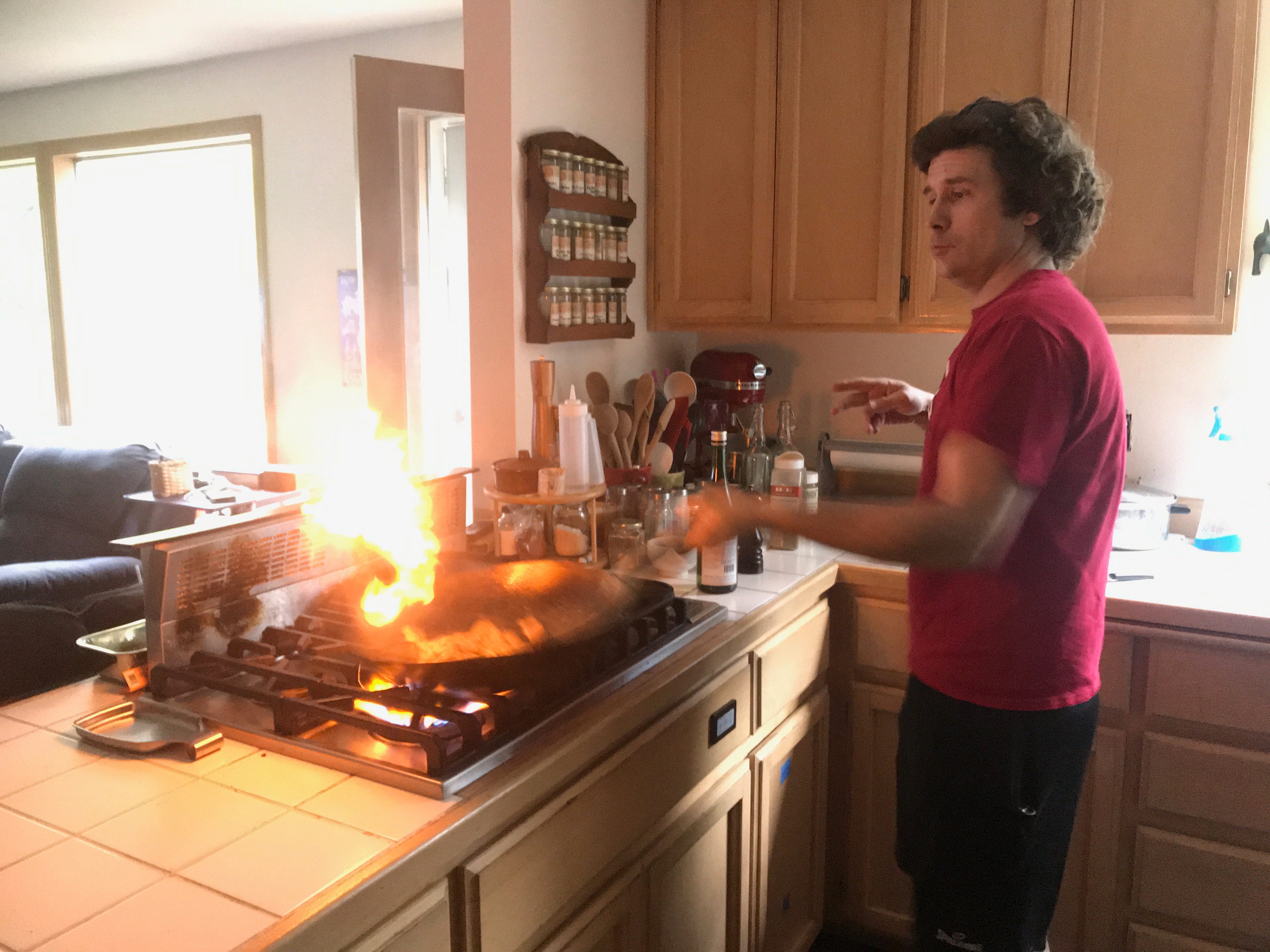
JAKE: I’ve been cooking on basically the same pans for most of my life, but they cook very differently on this stove than they did in our last stove.
AUGUST: And that was even the same kind of heat, induction, but one is a higher quality and thus has a higher potential for heat. You had to learn the different numbers and how long to keep something at those numbers.
JAKE: Or before that when we had a gas burner. The gas burner was great. It was very even heat distribution. All my pans worked very consistently… but it was not anywhere near as hot as I can get this [induction] stove.
So even 26 years into learning how to cook, I still have to stop and reassess, and I have to do that every time I buy a new pan. I have to do that every time I’m trying a new protein on that pan. It’s just always different, and seeing what’s happening is the thing that you need to learn how to do. And there’s not a perfection state until you’ve mastered an individual recipe.
What you’re learning to do as a cook isn’t “read a recipe,” it’s “read [what’s] cooking and understand what’s actually happening to the food by [real world] observation.” If your chicken is shrinking on the grill, it’s cooking too hot. If your burgers are falling apart, they’re probably cooking too cold. You just learn these things over time, and the recipes become nothing but ingredient lists.
AUGUST: Well, perfect segue, because I was going to talk a little bit more about specifically the WHY AREN’T YOU COOKING? method, which is about repeating those processes and making tweaks over time, whether it’s to the ingredients, the spices or even the cooking methods, so that you can get used to all of these things in the context of something you want to eat. And that’s important for two really big reasons.
One is that you want to actually enjoy yourself at the end of this hard process and the work it takes to do that. But two, you’ve got to be able to know, did I get it right or is it wrong? If you pick something you don’t really like to eat or that you’re not super familiar with, you wouldn’t be able to know if you got it right.
That’s really at the heart of the WHY AREN’T YOU COOKING? method: identifying stuff that you wanna eat to help you build those basic skills until you’re able to tweak the recipe, refine it, and try different things. I have to ask: did you come up with that method? Or was that something that you learned from how you were taught?
JAKE: The WHY AREN’T YOU COOKING? method came from a dissatisfaction with how the way we train professional chefs doesn’t jive with how you train a real cook for a real restaurant.
AUGUST: So… the academic versus the applied?
JAKE: Correct. I went to school and I learned how to function in a commercial kitchen. And I bounced around between all kinds of different restaurants because everywhere I went kind of sucked. These places didn’t have good processes to [help you] understand what made their restaurant different. And I worked for some places that were truly awesome and with great chefs that knew cool stuff. I learned great stuff about food, but I watched them churn through employees because you can’t just get it right if there’s no way to bring people on board.
So I bounced from high-end seafood restaurants and steakhouses downtown, to Italian restaurants and fancy upscale dining on the east side, and then did some institutional cooking in retirement homes and eventually landed in a catering company. The folks at Dupar and Co. in Redmond taught me everything I know. The WHY AREN’T YOU COOKING? process came from how I was trained there.
If you can teach somebody how to make their comfort foods, they’ll start cooking for themselves. One of the companies that I worked in was based out of a school, and [a whole lot of kids got] really excited about different versions of foods they loved. Once they were excited about food, they were interested in it, and a whole bunch of them learned how to cook things for themselves. So realizing that it worked for professionals, it worked for civilians, and it was even relatively effective on kids… it seemed like something that I might should codify into a process.
And we did! We took this approach and broke it down systematically in a way anyone can apply in their own life. In this 33k-word nonfiction book, you’ll find:
🦾 Actions to take after every chapter!
📃 Lists upon lists!
🍲 Recommendations for stocking your kitchen!
🛒 Tips for grocery shopping!
🛟 Painless food safety!
🥗 Flexible recipes!
👉👨🍳 Start or continue your own cooking journey today with a discounted copy of WHY AREN’T YOU COOKING?, just $0.99 when you buy it from me directly! 👩🍳👈
👉 Or grab it for $1.99 from your favorite online retailer! 👈
What do you like to cook (or eat!) the most? Reply and tell me, I’m a recipe hoarder!
Alright… content aside, a book gets judged by its cover. And while I liked the first cover, I was on a budget and my cover artist was limited to what he could find in the couple of stock collections he has access to. The original cover for WHY AREN’T YOU COOKING? didn’t really do the professionalism of the content justice, because of what was available in stock illustrations.
And now that it’s been out in the world for nearly six years, I wanted to give this labor of love a labor of love of its own: a new custom cover.
I hired talented illustrator Reno Carrillo to give WHY AREN’T YOU COOKING? new life, and he absolutely delivered. Here is the new cover in all of its bright glory!
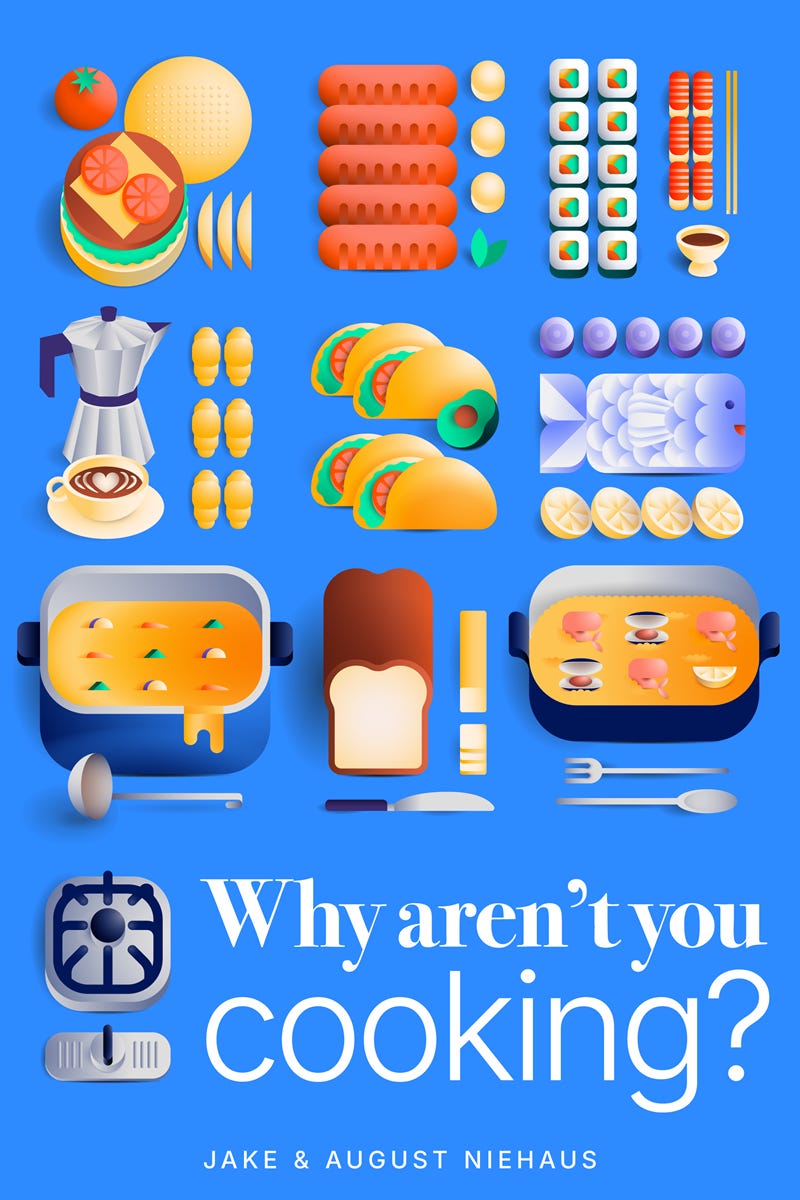
It’s obvious (to my eye, at least) that this was a human’s labor of love. I wanted the illustration to display the same care and sense of “made with love” that food cooked at home is.
👉 If you’d like to exchange a review for a FREE copy of WHY AREN’T YOU COOKING?, grab it today from Booksprout! 👈
Do you know how excited I am to have found an author local to me who’s writing action-mystery books… about animals who communicate unexpectedly?!
Indie author Mark Jenkins is back with Shin of the Ravenfin, an adventure set in the North Pacific involving a man named Shin, an orca named Mothersong, and hunters determined to claim their whale. Readers are raving:
⭐⭐⭐⭐⭐
“The author takes us into the world of Orcas and how they communicate, what their hierarchy looks like, how their pods operate, and so much more.”
⭐⭐⭐⭐⭐
“As a lover of sea creatures, especially cetaceans, this book was a must read.”

Snap up your copy of Shin of the Ravenfin today! 🚢🐳
The Free-zer
It’s another installment of THE FREE-ZER—the section where you’ll find something that will cost you zero monies. (That’s no dollars, cents, pounds, pesos, Republic credits, Monopoly money, latinum, or dubloons.)
👉 Dive in or go back for seconds from the TURN OVER A NEW LEAF bundle of free stories, now until December 7. Get your own free copy of:
🏜️ Pursuit, an action-adventure short about love, invasion, and tough choices
🦁 The Deadly Reckonings, a fated mate story set in a fierce world
🐺 Rebirth, a YA fantasy romance with shifters

👉 You can still get free stories from the FREE SCIENCE FICTION / FANTASY STORIES bundle from Storyorigin, including:
🐺 My own SEEKER, a novella about a stalwart daugment spy
🕰️ The Janitor’s Temporal Dilemma, a time travel short story
🧑🌾 Fetch, urban fantasy about an intern thwarting a chupacabra crime ring
👉 Maybe you’ve already read SEEKER, and you’d like to see how that story continues. Lucky you! My serial story THE ADVENTURES OF SEEKER AND THE SERPENTS has a new chapter this week. Jump back into the story, if you’ve been following along, or start with the first chapter!
Happy holidays to you and yours—I’m grateful for you!
August
It’s common sense when you think about (starting with something you already like) sometimes we need it pointed out.
It’s a component of write what you know or write the book you wanna read. Start where the love already is, then digging in before branching out is easier.
Awesome share!
NO FETA???? 😂 Though I do find it too strong sometimes, it's sooooo good!!